2 Layers PE Tube VS 5 Layers PE Tube: Barrier Performance Explained
Oct 21, 2026
2 Layers PE Tube VS 5 Layers PE Tube: Barrier Performance Explained
Choosing the right cosmetic tube packaging is about more than appearance and cost. The tube structure directly affects product protection, compatibility, shelf life, and overall packaging performance. Among the available options, 2-layer PE tubes and 5-layer PE tubes are commonly considered for skincare, personal care, and cosmetic packaging applications.
Although both structures can be used for cosmetic products, they differ in their material composition, barrier properties, and suitability for different formulations. Understanding these differences helps cosmetic brands, skincare manufacturers, and packaging buyers make informed decisions.
In this guide, we explain how 2-layer and 5-layer PE tubes work, compare their barrier performance, and explore which structure may be more suitable for your product.
1. What Is a 2-Layer PE Tube?
A 2-layer PE tube is a type of cosmetic packaging tube made with two polyethylene-based layers. Depending on the manufacturer's design, these layers may use different PE grades or formulations to balance flexibility, strength, appearance, and processing performance.
PE, or polyethylene, is widely used in cosmetic packaging because it offers good flexibility, moisture resistance, and durability. It is also suitable for a wide range of everyday personal care products.
Key Features of 2-Layer PE Tubes
Simple material structure: A relatively straightforward construction with two PE-based layers.
Good flexibility: Suitable for squeeze tubes designed for convenient dispensing.
Moisture resistance: PE provides a useful barrier against water vapor, helping reduce moisture exchange through the packaging.
Cost efficiency: A simpler structure may help reduce material and manufacturing costs, depending on tube specifications and production volume.
Versatile applications: Commonly considered for lotions, cleansers, creams, gels, and other compatible personal care formulations.
Typical Applications
2-layer PE tubes can be a practical choice for products that do not require a particularly high oxygen barrier or other specialized protection.
Examples include:
Facial cleansers
Hand creams
Body lotions
Moisturizing gels
Basic skincare creams
Hair care products with compatible formulations
However, not every formula is suitable for a standard 2-layer PE tube. Formulation compatibility, storage conditions, product shelf life, and the required barrier level should all be evaluated before making a final decision.
2. What Is a 5-Layer PE Tube?
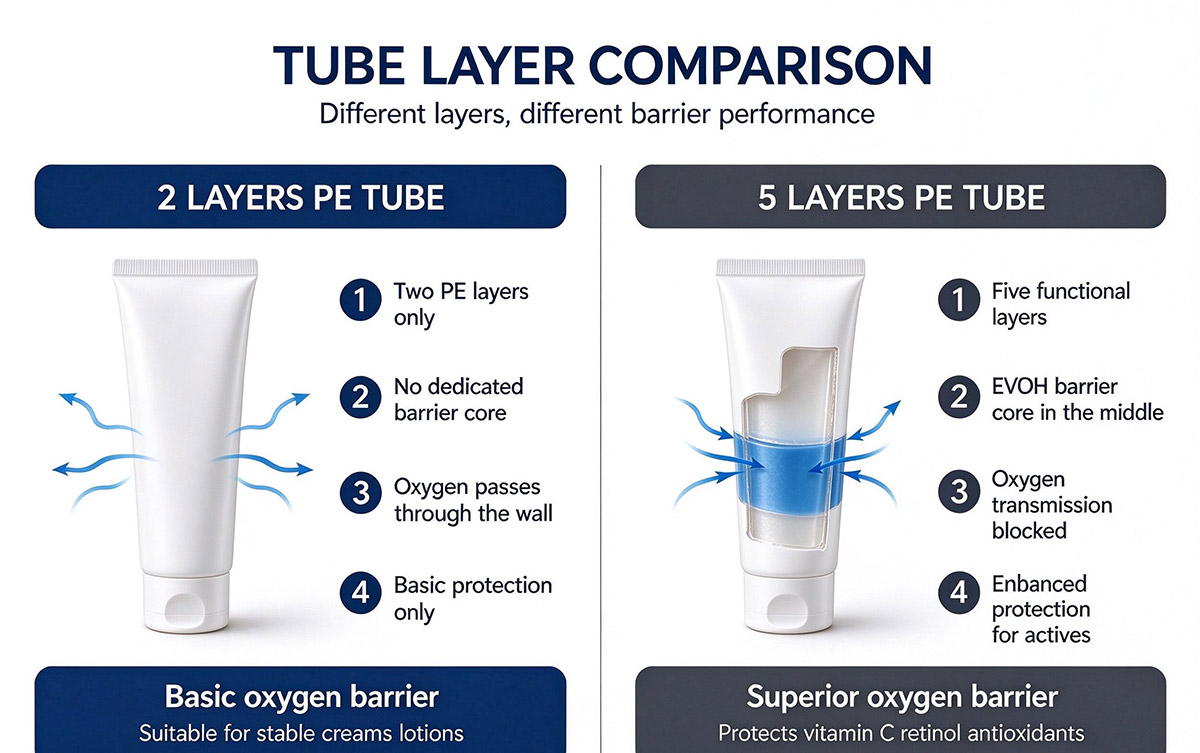
A 5-layer PE tube is a multilayer packaging tube designed with five functional material layers. A common construction may incorporate PE layers and a dedicated barrier layer, such as EVOH, to improve protection against oxygen transmission.
The exact composition varies by manufacturer. Some structures use tie layers to bond materials that would not adhere effectively on their own, while other designs may use different barrier materials or layer arrangements.
The key advantage is that a properly designed 5-layer structure can combine the processing and squeeze characteristics of PE with the enhanced barrier properties of another material.
Key Features of 5-Layer PE Tubes
Enhanced oxygen barrier: When the structure includes an effective barrier material such as EVOH, it can significantly reduce oxygen transmission compared with a conventional PE-only structure.
Improved product protection: Reduced oxygen exposure can help protect formulations that are sensitive to oxidation.
Multilayer functionality: Different layers can provide structural support, bonding, and barrier performance.
Potential shelf-life benefits: Better barrier performance may help preserve product quality when oxidation is a major degradation factor.
Flexible packaging design: Multilayer structures can be engineered for different cosmetic applications and product requirements.
Typical Applications
5-layer PE tubes may be worth considering for:
Vitamin C skincare products
Certain antioxidant-rich formulations
Selected active-ingredient creams
Specialty skincare treatments
Formulations containing oxidation-sensitive ingredients
Products requiring more stringent oxygen-barrier performance
These are potential applications rather than universal rules. The suitability of a tube depends on the full formulation, the actual barrier specification, and compatibility testing.
3. 2 Layers PE Tube vs. 5 Layers PE Tube: Key Differences
The most important distinction is not simply the number of layers. It is the material used in each layer and the performance required by the packaged product.
Comparison Factor
2-Layer PE Tube
5-Layer PE Tube
Basic structure
Two PE-based layers
Five functional material layers
Oxygen barrier
Generally limited for conventional PE-only structures
Can be significantly improved with an effective barrier layer
Moisture barrier
Good, depending on PE grade and tube design
Depends on the complete multilayer structure
Product protection
Suitable for many conventional formulations
Useful for formulations requiring enhanced oxygen protection
Flexibility
Generally good
Depends on layer thickness and material composition
Manufacturing complexity
Relatively simple
More complex multilayer construction
Cost considerations
Often more economical
May involve higher material and processing costs
Typical applications
Cleansers, lotions, creams, and gels
Selected oxidation-sensitive or barrier-demanding formulations
Best selection criteria
Standard protection and cost efficiency
Verified barrier requirements and formulation stability
Important: These comparisons describe typical PE-only and barrier-enhanced designs. A 5-layer tube is not automatically superior in every performance category. Actual results depend on the material combination, layer thickness, tube dimensions, manufacturing quality, and testing conditions.
4. How Does Barrier Performance Affect Cosmetic Products?
Barrier performance describes how effectively packaging limits the movement of substances such as oxygen, water vapor, and volatile ingredients through the packaging wall.
For cosmetic products, the most relevant factors often include oxygen transmission, moisture transmission, and the retention of key formulation components.
4.1 Oxygen Barrier
Oxygen can contribute to oxidation in certain cosmetic formulations. Depending on the ingredients, oxidation may lead to color changes, odor changes, reduced active-ingredient content, or other changes in product quality.
PE provides many useful packaging properties, but conventional PE structures are generally not high-performance oxygen barriers.
A 5-layer tube containing a suitable barrier layer, such as EVOH, may reduce oxygen transmission substantially. This can be valuable when a formulation is sensitive to oxygen exposure.
However, the degree of protection must be confirmed using the actual tube specification and appropriate test data. Oxygen can also enter through the cap, closure interface, or other parts of the package, so the complete packaging system matters.
4.2 Moisture Barrier
Moisture transfer can affect a cosmetic product's weight, viscosity, concentration, and overall stability.
Polyethylene generally provides good resistance to water vapor. Both 2-layer and 5-layer tube designs can offer useful moisture protection, although their actual performance may differ according to the materials and thicknesses used.
A multilayer construction should not automatically be assumed to provide better moisture resistance. The specific structure must be evaluated against the product's requirements.
4.3 Protection Against Volatile Ingredient Loss
Some formulations contain ingredients that may gradually evaporate or migrate through packaging materials. Fragrance components and certain solvents may require special attention.
The appropriate tube structure depends on the chemical properties of the formulation, the compatibility of the materials, and the required retention performance.
For products containing sensitive or volatile ingredients, packaging compatibility and mass-loss testing can help determine whether a standard PE tube is sufficient.
4.4 Maintaining Product Quality During Storage
A cosmetic formula may be exposed to oxygen, temperature changes, light, and other environmental factors throughout storage and distribution.
Better barrier performance can help control one part of this exposure, but it does not guarantee a longer shelf life on its own.
The product formulation, preservative system, filling process, closure integrity, storage conditions, and packaging compatibility all contribute to the final result. Stability testing using the intended packaging is therefore essential.
5. Does a 5-Layer PE Tube Always Have Better Barrier Performance?
Not necessarily in every respect.
A 5-layer tube with a properly selected oxygen-barrier material can offer better oxygen protection than a conventional 2-layer PE tube. However, the number of layers alone does not establish the barrier performance.
Several factors influence the final result:
1. Barrier material
EVOH is commonly used as an oxygen-barrier material in multilayer packaging. Other structures may use different materials, each with its own properties and limitations.
2. Barrier-layer thickness
A barrier material must be present in an appropriate thickness and configuration to achieve the required performance.
3. Tube wall thickness and diameter
The packaging dimensions and total wall construction affect the amount of material available to resist permeation. Results should be compared under equivalent test conditions.
4. Manufacturing quality
Layer uniformity, bonding quality, pinholes, and other production defects can affect the integrity of a multilayer tube.
5. Closure and package design
The tube shoulder, nozzle, cap, and closure interface may influence overall product protection. The tube wall is only one part of the complete package.
For this reason, buyers should request technical specifications and test data rather than selecting a tube solely by its layer count.
6. Which PE Tube Structure Is Better for Your Product?
The right choice depends on your formula, target market, budget, and packaging requirements.
Choose a 2-Layer PE Tube If:
Your formulation is compatible with the selected PE materials.
Standard moisture protection meets your product requirements.
A high oxygen barrier is not necessary.
Cost efficiency is a major consideration.
You are developing conventional cleansers, lotions, creams, or gels.
Consider a 5-Layer PE Tube If:
Your formulation is sensitive to oxygen exposure.
You need a verified improvement in oxygen-barrier performance.
Your stability testing indicates that oxygen transmission is a relevant risk
Contact : info@runkgroup.com | +86-13128608159
Runk Website :
https://www.runkgroup.com/
https://www.runkbottle.com/
https://runkpackaging.en.alibaba.com/
Based in Guangzhou, China – serving beauty brands worldwide.
LEER MÁS




 Red IPv6 compatible
 Español


